
Artificial Intelligence | Pros, Cons, Debate, Arguments, Computer Science, & Technology


Scientists Built A Badminton-playing Robot With AI-powered Skills
It also learned fall avoidance and determined how much risk was reasonable to take given its limited speed. The robot did not attempt impossible plays that would create the potential for serious damage—it was committed, but not suicidal.
But when it finally played humans, it turned out ANYmal, as a badminton player, was amateur at best.
The first problem was its reaction time. An average human reacts to visual stimuli in around 0.2–0.25 seconds. Elite badminton players with trained reflexes, anticipation, and muscle memory can cut this time down to 0.12–0.15 seconds. ANYmal needed roughly 0.35 seconds after the opponent hit the shuttlecock to register trajectories and figure out what to do.
Part of the problem was poor eyesight. "I think perception is still a big issue," Ma said. "The robot localized the shuttlecock with the stereo camera and there could be a positioning error introduced at each timeframe." The camera also had a limited field of view, which meant the robot could see the shuttlecock for only a limited time before it had to act. "Overall, it was suited for more friendly matches—when the human player starts to smash, the success rate goes way down for the robot," Ma acknowledged.
But his team already has some ideas on how to make ANYmal better. Reaction time can be improved by predicting the shuttlecock trajectory based on the opponent's body position rather than waiting to see the shuttlecock itself—a technique commonly used by elite badminton or tennis players. To improve ANYmal's perception, the team wants to fit it with more advanced hardware, like event cameras—vision sensors that register movement with ultra-low latencies in the microseconds range. Other improvements might include faster, more capable actuators.
"I think the training framework we propose would be useful in any application where you need to balance perception and control—picking objects up, even catching and throwing stuff," Ma suggested. Sadly, one thing that's almost certainly off the table is taking ANYmal to major leagues in badminton or tennis. "Would I set up a company selling badminton-playing robots? Well, maybe not," Ma said.
Science Robotics, 2025. DOI: 10.1126/scirobotics.Adu3922
MongoDB Atlas Database For Government,
Federal agencies are grappling with an ever-expanding deluge of unstructured data—from text documents and emails to images, videos, surveillance footage, and sensor outputs—critical for everything from national security to public health.
That explosion of unstructured data presents a formidable challenge: how to effectively store, correlate, and analyze such diverse information in combination with structured data in order to make better-informed decisions. The traditional, rigidly structured databases that have long served as the backbone of government data systems are often ill-equipped for this task, highlighting an urgent need for more agile and flexible database platforms.
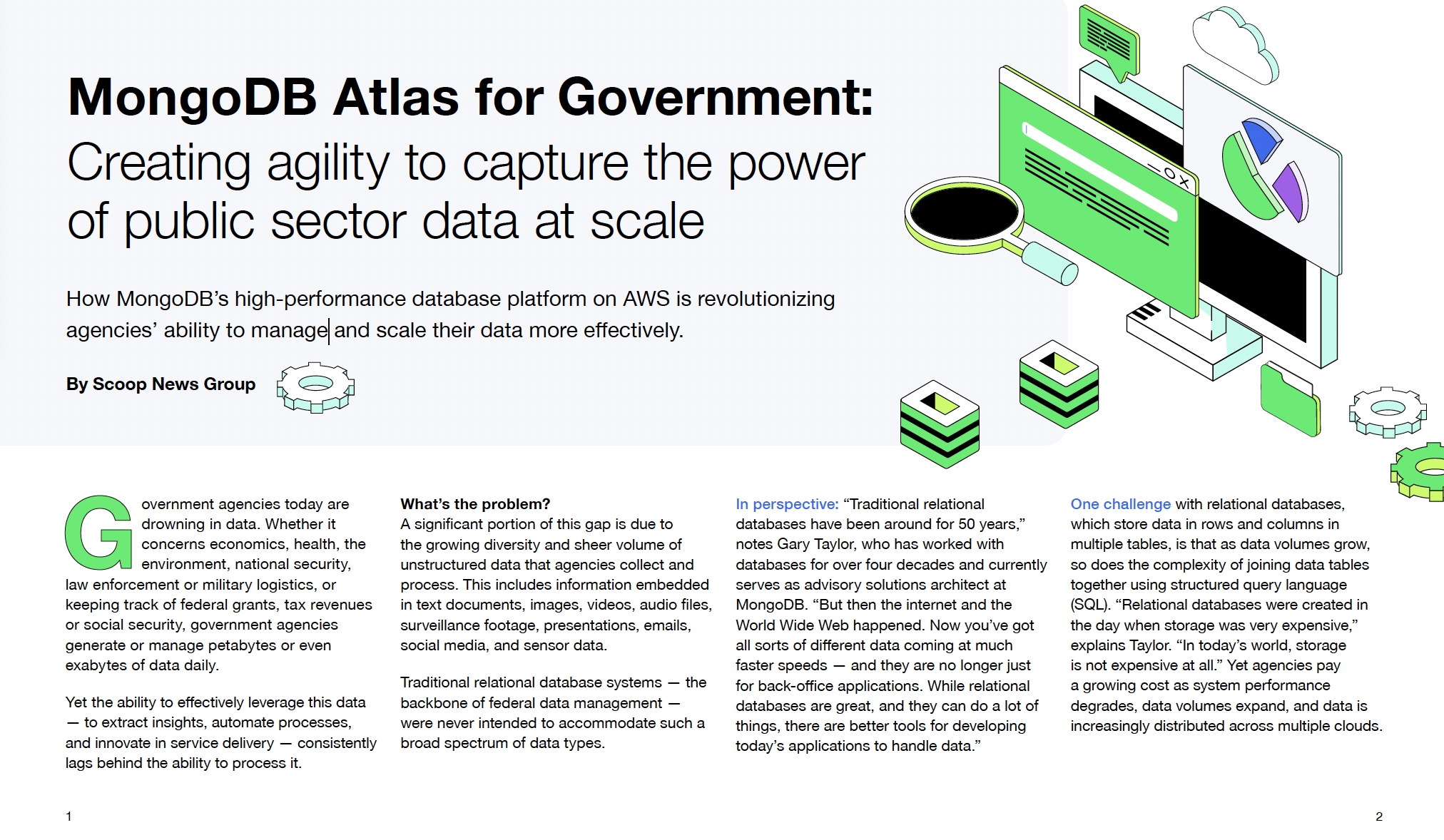 Download the full report.
 This necessity is further amplified by the rapid advancements in Artificial Intelligence (AI). As agencies look to leverage AI for real-time decision-making, predictive analytics, and enhanced citizen services, the ability to seamlessly integrate and process vast quantities of varied data becomes paramount. The next generation of database platforms, such as MongoDB Atlas for Government, provides agencies with a powerful set of flexible and cost-effective capabilities designed to handle data complexity and volume at scale.
These insights are central to a new report, "MongoDB Atlas for Government: Creating agility to capture the power of public sector data at scale," published by Scoop News Group and underwritten by MongoDB and Amazon Web Services (AWS). The report examines the distinct capabilities of modern database solutions and how they can revolutionize federal agencies' ability to manage and scale their data more effectively.
Gary Taylor, advisory solutions architect at MongoDB, explains in the report, "Traditional relational databases were created in the day when storage was very expensive… In today's world, storage is not expensive at all. Yet agencies pay a growing cost as system performance degrades, data volumes expand, and data is increasingly distributed across multiple clouds."
MongoDB's "document" approach to database development is widely recognized as a preferred platform, "built by developers for developers," says database industry analyst John Foley in the report. "It's particularly well suited for agile prototyping and iteration and for getting the project moving forward quickly," he says.
MongoDB Atlas for Government,
The report highlights several key advantages agencies can gain by leveraging MongoDB Atlas database capabilities, including:
The report further details MongoDB's multi-modal advantages, its cloud-native architecture on AWS, and features like Queryable Encryption for enhanced data security. It underscores that by adopting such modern platforms, federal agencies are better equipped to manage the current data deluge and unlock its immense potential, driving innovation and improving mission outcomes in an increasingly AI-driven world.
Download the full report.
This article was produced by Scoop News Group for FedScoop and sponsored by MongoDB and AWS.
Written by Scoop News Group Scoop News Group is the parent company and publisher of FedScoop. "Sponsored content" from Scoop News Group is original content produced by SNG Content Studio, a subsidiary of Scoop News Group. While the content conforms with FedScoop's editorial and design standards, it is developed in consultation with and sponsored by Scoop News Group clients and is not produced by FedScoop's editorial staff.
Pioneering Cancer Plasticity Atlas Will Help Predict Response To Cancer Therapies
The Wellcome Sanger Institute, Parse Biosciences, and the Computational Health Center at Helmholtz Munich today announced a collaboration to build the foundation of a single cell atlas, focused on understanding and elucidating cancer plasticity in response to therapies. The collaboration will catalyze an ambitious future phase to develop a cancer plasticity atlas encompassing hundreds of millions of cells.
Utilizing novel organoid perturbation and Artificial Intelligence (AI) platforms, the aim is to create a comprehensive dataset to fuel foundational drug discovery models and cancer research.
Dr. Mathew Garnett, Group Leader at the Sanger Institute, and Prof. Fabian Theis, Director of the Computational Health Center at Helmholtz Munich and Associate Faculty at the Sanger Institute, will be the principal investigators in the collaboration.
Garnett's research team has generated novel 3D organoid cultures that serve as highly scalable and functional cancer models with the ability to capture hallmarks of patient tumors. The team will use vast numbers of these tumor organoids — mini tumors in a dish — as a model to better understand cancer mechanisms of plasticity and adaptability in response to treatments.
Theis' research team has been widely recognized for pioneering computational algorithms to solve complex biological challenges at the intersection of Artificial Intelligence and single cell genomics, in this context for in silico modeling of drug effects on cellular systems. The initiative will be run through Parse Biosciences' GigaLab, a state-of-the-art facility purpose built for the generation of massive scale single cell RNA sequencing datasets at unprecedented speed.
The Sanger, Helmholtz Munich, and Parse teams have developed automated methods to streamline laboratory procedures in addition to the computational methods required to analyze and discover insights within datasets of this size.
The ultimate aim of the collaboration is to build a single cell reference map that will enable virtual cell modeling and potentially help predict the effect of drugs in cancer patients – where resistance might develop, from which compounds, and where to target future treatment efforts.
Garnett, Group Leader at the Wellcome Sanger Institute and collaboration co-lead, said: "We have developed a transformational platform to enable both large-scale organoid screening and the downstream data generation and analysis which has the potential to redefine our understanding of therapeutic responses in cancer. We aim to develop a community that brings the best expertise from academia and industry to progress the project. Studies of this magnitude are critical to the development of foundational models to better help us understand cancer progression and bring much needed advancement in the field."
Theis, Director of the Computational Health Center at Helmholtz Munich and collaboration co- lead, said: "Our vision of a virtual cell perturbation model is becoming increasingly feasible with recent advances in AI — but to scale effectively, we need large, high-quality single cell perturbation datasets. This collaboration enables that scale, and I'm excited to move toward AI- driven experimental design in drug discovery."
Dr. Charlie Roco, Chief Technology Officer at Parse Biosciences, said: "We are incredibly excited to bring the power of GigaLab to visionary partners. Leveraging Parse's Evercode chemistry, the GigaLab can rapidly produce large single cell datasets with exceptional quality. Combining the expertise of the Wellcome Sanger Institute and Helmholtz Munich with the speed and scale achieved by the GigaLab enable the opportunity to fundamentally change our understanding of cancer."
Is the form not loading? If you use an ad blocker or browser privacy features, try turning them off and refresh the page.



Comments
Post a Comment