
What Is NLP (Natural Language Processing)?


Google Coral
As machine learning and artificial intelligence becomes more widespread, so do the number of platforms available for anyone looking to experiment with the technology. Much like the single board computer revolution of the last ten years, we're currently seeing a similar revolution with the number of platforms available for machine learning. One of those is Google Coral, a set of hardware specifically designed to take advantage of this new technology. It's missing support to work with certain hardware though, so [Ricardo] set out to get one working with a Raspberry Pi Zero with this smart camera build based around Google Coral.
The project uses a Google Coral Edge TPU with a USB accelerator as the basis for the machine learning. A complete image for the Pi Zero is available which sets most of the system up right away including headless operation and includes a host of machine learning software such as OpenCV and pytesseract. By pairing a camera to the Edge TPU and the Raspberry Pi, [Ricardo] demonstrates many of its machine learning capabilities with several example projects such as an automatic license plate detector and even a mode which can recognize whether or not a face mask is being worn, and even how correctly it is being worn.
For those who want to get into machine learning and artificial intelligence, this is a great introductory project since the cost to entry is so low using these pieces of hardware. All of the project code and examples are available on [Ricardo]'s GitHub page too. We could even imagine his license plate recognition software being used to augment this license plate reader which uses a much more powerful camera.
Google Launches AI Platform That Looks Remarkably Like A Raspberry Pi
Google has promised us new hardware products for machine learning at the edge, and now it's finally out. The thing you're going to take away from this is that Google built a Raspberry Pi with machine learning. This is Google's Coral, with an Edge TPU platform, a custom-made ASIC that is designed to run machine learning algorithms 'at the edge'. Here is the link to the board that looks like a Raspberry Pi.
This new hardware was launched ahead of the TensorFlow Dev Summit, revolving around machine learning and 'AI' in embedded applications, specifically power- and computationally-limited environments. This is 'the edge' in marketing speak, and already we've seen a few products designed from the ground up to run ML algorithms and inference in embedded applications. There are RISC-V microcontrollers with machine learning accelerators available now, and Nvidia has been working on this for years. Now Google is throwing their hat into the ring with a custom-designed ASIC that accelerates TensorFlow. It just so happens that the board looks like a Raspberry Pi.
What's On The BoardOn board the Coral dev board is an NXP i.MX 8M SOC with a quad-core Cortex-A53 and a Cortex-M4F. The GPU is listed as 'Integrated GC7000 Lite Graphics'. RAM is 1 GB of LPDDR4, Flash is provided with 8GB of eMMC, and WiFi and Bluetooth 4.1 are included. Connectivity is provided through USB, with Type-C OTG, a Type-C power connection, a Type-A 3.0 host, and a micro-B serial console. Gigabit Ethernet, a 3.5mm audio jack, a microphone, full-size HDMI, 4-lane MIPI-DSI, and 4-lane MIPI-CSI2 camera support. The GPIO pins are exactly — and I mean exactly — like the Raspberry Pi GPIO pins. The GPIO pins provide the same signals in the same places, although due to the different SOCs, you will need to change a line or two of code defining the pin numbers.
You might be asking why Google would build a Raspberry Pi clone. That answer comes in the form of a machine learning accelerator chip implanted on the board. Machine learning and AI chips were popular in the 80s and everything old is new again, I guess. The Google Edge TPU coprocessor has support for TensorFlow Lite, or 'machine learning at the edge'. The point of TensorFlow Lite isn't to train a system, but to run an existing model. It'll do facial recognition.
The Coral dev board is available for $149.00, and you can order it on Mouser. As of this writing, there are 1320 units on order at Mouser, with a delivery date of March 6th (search for Mouser part number 212-193575000077).
Also In Dongle Form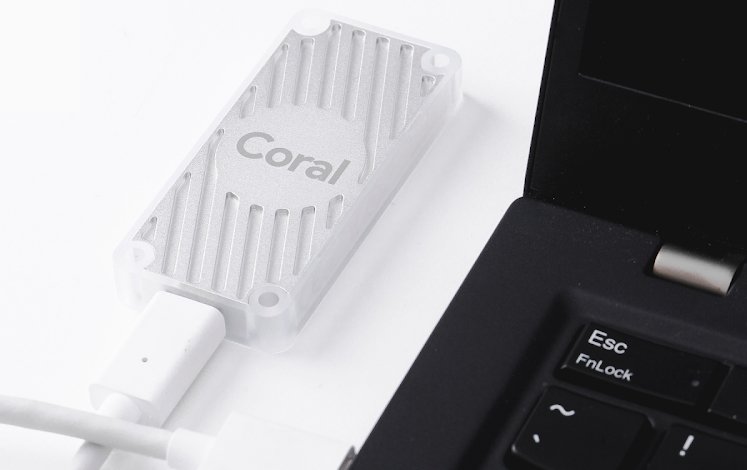 There's also another device in the hardware portfolio, called a USB accelerator, which we can only assume is the Edge TPU connected to a USB cable. This USB accelerator will work with the Raspberry Pi — that's from Google's product copy, by the way — and will get you started on machine learning inferencing with the Edge TPU designed by Google. The price for this USB accelerator is $75 USD.
We would like to congratulate the Raspberry Pi foundation for creating something so ubiquitous even Google feels the need to ride the coat tails.
Coral Is Google's Quiet Initiative To Enable AI Without The Cloud
TechCoral is Google's quiet initiative to enable AI without the cloudOn-device AI promises to make computers faster and more secure
On-device AI promises to make computers faster and more secure
by James VincentJan 14, 2020, 3:23 PM UTCLinkFacebookThreads Some of Coral's hardware products, including an AI accelerator (far right) and dev board (center).Image: Coral
 James Vincent is a senior reporter who has covered AI, robotics, and more for eight years at The Verge.
AI allows machines to carry out all sorts of tasks that used to be the domain of humans alone. Need to run quality control on a factory production line? Set up an AI-powered camera to spot defects. How about interpreting medical data? Machine learning can identify potential tumors from scans and flag them to a doctor.
But applications like this are useful only so long as they're fast and secure. An AI camera that takes minutes to process images isn't much use in a factory, and no patient wants to risk the exposure of their medical data if it's sent to the cloud for analysis.
These are the sorts of problems Google is trying to solve through a little-known initiative called Coral.
"Traditionally, data from [AI] devices was sent to large compute instances, housed in centralized data centers where machine learning models could operate at speed," Vikram Tank, product manager at Coral, explained to The Verge over email. "Coral is a platform of hardware and software components from Google that help you build devices with local AI — providing hardware acceleration for neural networks ... Right on the edge device."
Coral's products, like the dev board (above), can be used to prototype new AI devices.Image: GoogleYou might not have heard of Coral before (it only "graduated" out of beta last October), but it's part of a fast-growing AI sector. Market analysts predict that more than 750 million edge AI chips and computers will be sold in 2020, rising to 1.5 billion by 2024. And while most of these will be installed in consumer devices like phones, a great deal are destined for enterprise customers in industries like automotive and health care.
To meet customers' needs Coral offers two main types of products: accelerators and dev boards meant for prototyping new ideas, and modules that are destined to power the AI brains of production devices like smart cameras and sensors. In both cases, the heart of the hardware is Google's Edge TPU, an ASIC chip optimized to run lightweight machine learning algorithms — a (very) little brother to the water-cooled TPU used in Google's cloud servers.
While its hardware can be used by lone engineers to create fun projects (Coral offers guides on how to build an AI marshmallow-sorting machine and smart bird feeder, for example), the long-term focus, says Tank, is on enterprise customers in industries like the automotive world and health care.
As an example of the type of problem Coral is targeting, Tank gives the scenario of a self-driving car that's using machine vision to identify objects on the street.
"A car moving at 65 mph would traverse almost 10 feet in 100 milliseconds," he says, so any "delays in processing" — caused by a slow mobile connection, for example — "add risk to critical use cases." It's much safer to do that analysis on-device rather than waiting on a slow connection to find out whether that's a stop sign or a street light up ahead.
Tank says similar benefits exist with regard to improved privacy. "Consider a medical device manufacturer that wants to do real time analysis of ultrasound images using image recognition," he says. Sending those images to the cloud creates a potential weak link for hackers to target, but analyzing images on-device allows patients and doctors to "have confidence that data processed on the device doesn't go out of their control."
Google's Edge TPU, a tiny processing chip optimized for AI that sits at the heart of most Coral products.Image: GoogleAlthough Coral is targeting the world of enterprise, the project actually has its roots in Google's "AIY" range of do-it-yourself machine learning kits, says Tank. Launched in 2017 and



Comments
Post a Comment